Chapter 3: What Advantage Has The Jew

Romans 1:18-32 is Paul’s exposition of the state of the Gentiles apart from the saving grace of the gospel.

Romans 2:1-3:8 is Paul addressing those who are only outwardly Jew. Meaning those who believe salvation comes from circumcision or following other Jewish customs (as though genetics and rituals are enough to save them from God’s wrath).

Some may hear Paul’s words and assume he means that circumcision is worthless. Paul uses Chapter 3 to explain the purpose circumcision and the Jews in general (God’s chosen people), serve.

The primary advantage the Jews had over the Gentiles was that they had received the oracles of God (oracles of God = words of God).   There was a divine promise extended to the Jews and by faith, they were to await its fulfillment. God initially granted the promise of the gospel and of son-ship to the Jews. The Jews were the only recipients of the promise when it was given. Circumcision was to be a reminder of God’s promise and a sign to show that you were among those who had received the promise.

Yes, the Jews had the advantage of being the initial recipients of God’s promises. To say otherwise would suggest that the covenant God made with Abraham had no value. To go a step further, it would suggest that God is a liar. If He had made a covenant with them based on circumcision, how could He now extend the same covenant to the Gentiles, the uncircumcised, without violating His own covenant or rendering His covenant with the circumcised Jews invalid and useless?

After all, Genesis 17:14 says, “Any uncircumcised male, who has not been circumcised in the flesh, will be cut off from his people; he has broken my covenant.”

Let’s look back at what we’ve read.

We know the Jews were chosen by God to communicate the word of God both verbally and symbolically. It is important to note that the advantage of the Jew created a responsibility. They were to use the Law, the words given to them by God, to pursue righteousness. The Law in and of itself did not have the power to bring about a right-standing with God, but it was purposed to serve as a guide for how righteous living should look. We know from reading Romans Chapter 2 (or just about anywhere in the Old Testament) that thought the Jews prided themselves as the possessors of the Law, they weren’t even that great sticking to it.

The first three chapters of Romans give us a detailed look at the sinful nature of every human being. Paul makes it clear that sinfulness and depravity are universal. Both Jew and Gentile are guilty before the Lord.

Despite having the advantage of divine revelation, the Jews had not obtained a righteousness through the Law. The Law itself was good, but it was misused by its recipients. Neither outward circumcision nor simple possession of the Law could make the Jews right with God.

All that to say, yes, the Jews had a great advantage and the circumcision had great value, but if neither qualifier could release the grip of sin or save the soul from death, there is still great need to hear and respond in faith to the gospel of Jesus Christ.

The Jew, as much as the Gentile, should be delighted and humbled by the message of Romans 1:17, “But now apart from the Law the righteousness of God has been manifested.” The existence of a righteousness apart from the Law, the law which mankind couldn’t keep, is surely good news.
Recap: Tuesday, February 21st

I loved our time together this past Tuesday! I am excited about what the coming weeks will bring!

Each week I pray for God to give me a message to deliver to you all.  This past week that message was to encourage and challenge us to remember the wonder of what was accomplished for us on the cross.  I never want to cease to be amazed at the grace of God as though I am somehow entitled to His love and favor.

I started with a verse from Genesis 1:3 – And God said, “Let there be light”, and there was light.

Before He would spend the next six days creating the earth, I imagine God foreknew the beauty and wonder that would exist when He was finished.  Before any command was spoken into this dark and empty space, He knew that this ‘place’ would come to reflect His glory.  In order for all that He envisioned to be actualized, He began by calling forth light.

For centuries upon centuries, the message of Jesus Christ has been preached.  For centuries upon centuries people have responded to the gospel with either faith or indifference. The question I attempted to answer on Tuesday night was this: How might we explain what causes us to go from simple hears of the gospel, to a life marked by trust in the gospel which leads to the obedience of faith Paul describes in Romans 1 and 2?

Note this is MY view!

I believe there are two types of calls that go forth when the gospel is preached: a universal call and a divine-effectual call.

The universal call –

  • A universal call is what you and I, as recipients of grace, are obligated to preach.  Not because we owe it to God.  If we had to pay for what we received from His it could not be considered a gift given by grace.
  • When you hear good news about how to escape from a common misery, you become a debtor to tell the good news to others so they can escape the misery too. If you withhold the good news of grace from others, as if you were qualified for it, and they were not, then you show that you have never understood grace.
  • We are instructed by Jesus to carry the message of the gospel to the ends of the earth.  Our motivation is to see the name of the Lord proclaimed in all the earth and to see many be brought to faith in Jesus as their only hope to be reconciled to God.

A divine-effectual call –

  • The divine effectual call is the call that truly brings forth faith.
  • It causes a person to submit themselves to a God and theology that once seemed foolish.
  • It is spoken by God!
  • All who hear this call are saved!!

2 Corinthians 4: 6  says: For God, who said, “Let light shine out of darkness,”made His light shine in our hearts to give us the light of the knowledge of God’s glory displayed in the face of Christ.

You are not a believer simply because you heard a few stories that sounded good to you.  You are a believer because God gave you sight! He awakened your soul, softened the hardness of your heart and extended you grace so that you might see Jesus as the righteousness of God.  God’s divine-effectual call kindled in you a love for His name and His Son.

Just as God, knowing the fullness of His creative intent beforehand, called forth light in the earth, He has done the same in each of our hearts!  He spoke light into your life because He knows that when His work in you is complete, you will reflect His glory!

I pray that as we continue to study Romans we would be in awe of the beauty and mystery of amazing grace.

See you ladies next time!


Are We Rome?

Paul is writing to the Romans about 30 years after the resurrection of Jesus Christ. He has been preaching the gospel and planting churches for about 20 years by now.

The Christians being addressed in Romans had never received any face to face teaching, from any of the apostles. Since Paul’s previous attempts to visit Rome had been unsuccessful, this letter provided an alternative way to for him to teach on some of the greatest principles of the gospel. Paul’s Epistle to the Romans is a bit different from the letters he writes to other New Testament churches because the emphasis is focused more on God, His redemptive plan for mankind, and instructions for godly-living. His other letters tend to focus more on addressing conflicts and challenges within the churches.

Chapter 1 tells us that although Paul had not visited Rome in his missionary travels he was eager to get there. That’s interesting because Paul is virtually unknown in this area of the world and the One he would proclaim, Jesus, was not exactly a crowd favorite. To get an idea of how what it would be like to be a Roman Christian reading this letter, and to figure why Paul is so excited about them, let’s take a look at Rome, circa 58 A.D.

Rome was the capital of the largest empire in the world. It’s population at this time is estimated to be around one million people. Much like a modern day metropolitan city, it had beautiful architecture, great wealth, and was a thriving economic force. On the flip-side, much like a modern day metropolitan city, it also had many slums where large numbers of people lived in extreme poverty.   As the center of world commerce, many people would travel to Rome for business (or pleasure) from miles and miles away.

The Romans had a reputation for being an immoral and violent people. They enjoyed watching gladiators killing each other like barbarians and made sport out of watching slaves (and eventually Christians) being ripped apart by animals. You remember the movie Gladiator!

Christianity was not a state sanctioned religion at the time of Paul’s letter. It was more a fringe group, initially considered to be a bit wacky, yet harmless, by most Romans.

There is no Biblical evidence that points to a definitive origin of the church in Rome. Acts 2 mentions that several people from Rome were present at the Day of Pentecost. It seems that following their conversion by the work of the Holy Spirit, many of these Roman citizens carried the gospel back home with them. Over the course of time, it would have been natural for some Christians to migrate there for business and join the church that had been established.

Rome held power in the highest regard and the Romans were a proud and egocentric people. The idea of a Jewish savior, not to mention one who was crucified, was laughable to them. They considered anyone who embraced the message of Jesus Christ to be among the lowest class of people.

Christians in Rome eventually came to be referred to as ‘enemies of the human race’. They were often wrongfully accused of acts of incest and cannibalism. They were victims of grave persecution under Emperor Nero. Such persecution might involve being skewered, or drenched in oil and torched, or being thrown to the lions in the Roman sporting arenas.

Paul says in his letter that he doesn’t want the Christians in Rome to be unaware that he has planned to visit them many times. It is possible that by emphasizing this point, Paul is attempting to squash any rumors being circulated by unbelieving Romans that might suggest he (or any other apostolic missionary) was not bold enough to evangelize in Rome. Perhaps Paul is saying that in spite of all the cultured Greeks who would mock his preaching as foolishness, and the possibility of his own persecution, he eagerly and unashamedly desired to join the Christians in Rome to preach Christ and Him crucified.

So, what’s got Paul all excited??

Military power and economic success had all eyes fixed on Rome. Practically everything that happened in Rome would be magnified and the stories would be carried to other parts of the world. That meant that the testimonies of the Christians who lived there went viral (I guess that’s how we would say it in 2017)! Their strong faith in the Lord was becoming well known! Paul was thankful that faith in Jesus Christ was spreading throughout the Roman world and that it was producing good fruit in the believers in Rome. They represented a great light in a very dark and broken world.

In the midst a pagan and vile culture, these Christians had evidently been clinging tightly to the God of their salvation. They refused to conform to the patterns of the world around them and by the grace of God, they were standing firmly on the gospel.

I believe that as Christians living in 2017 there are some things we can learn from these Roman believers. As we live in a society that seems more broken and godless than ever, I pray that like the church in Rome, we would be found clinging tightly to the God of our salvation and standing firmly on His gospel so that believers all over the world might hear of our faithfulness and be encouraged.

Romans: FYI Jews and Gentiles

As we read through Romans we will see what appears to be a clash of cultures: Jews vs. Gentiles.  We will go a little deeper into this when we meet together but I wanted to give you something to take with you as you read Chapters 1 and 2.


A ‘Jew’ is a descendant of the patriarch, Israel.  Often times, the term ‘Jew’ and ‘Israelite’ are used interchangeably in the Bible.  They are also known as ‘God’s Chosen People’.

When God spoke to Abraham about 2000 years before Christ was born, He promised Abraham that he would have descendants through whom all nations of the earth would be blessed.  This promise was later extended to Isaac, son of Abraham, and later to Jacob, son of Isaac.  Jacob was given the name ‘Israel’ by God.  His descendants (the people of the twelve tribes, or his twelve sons) were referred to as the Israelites, and later, the Jews.
In very basic terms, a Jew is a descendant of Israel.
Practically everyone else was referred to as a Gentile.  So, unless you are born of Jewish blood, you are a Gentile. I am a Gentile.
The Jews regarded the Gentiles as pagans who did not know the truth of God.  Gentiles were considered unclean and were referred to as ‘dogs’, and the ‘true uncircumcision’.
As the gospel spread in the years after the Resurrection, many Gentiles were converted from paganism and became recipients of God’s new covenant promise.  Acts 11:18 says, “So then, even to the Gentiles, God has granted repentance that leads to life.”
Here are a few things to keep in mind as we continue to walk through Romans:
  • It is believed that the church in Rome was predominately Gentile.
  • Paul was a Jew, (he was a descendant of Benjamin, a son of Israel)
  • Many Jews in Rome still doubted that the righteousness of God could be revealed to the Gentiles
  • The covenants and promises of God were initially made solely to the Jews.  This is why the coming of Christ was truly good news to the Gentile!  The blood of Christ destroyed the barrier between Jew and Gentile and extended the right to receive eternal life to all who would, by grace, turn to the Lord in repentant faith. (see Ephesians 2:11-14)

I pray your time in God’s Word is sweet this week!

Recap: Tuesday, February 7th

I so enjoyed our time on Tuesday!! I am looking forward to spending the next several weeks with you ladies!!

My goal for Tuesday night was to cast a vision for where we are headed and to (hopefully) get us excited about coming together to study God’s word and grow in unity.

I started things off in Genesis 1:1-2

God created the heavens and the earth. The earth was without form and void [and darkness was over the face of the deep. And the Spirit of God was hovering over the face of the waters.]

The two words being translated here are tohu and bohu.

Tohu – means formless, a wasted space

Bohu – means empty

The first scene in our Bible is one of nothing but blank space.  Then our Triune God steps in and He speaks into existence order and life. He creates a structure and He creates life to inhabit the structure. The Bible introduces us to God as He is creating an environment for mankind that will be conducive to life, growth and flourishing.

In the beginning God pushed back chaos, that’s tohu, to make a home for us.

Like my God, I want to create a space for His people that is conducive to life, growth and flourishing. I want Tuesday nights to be a place pushes back the chaos in your life and allows for rest, peace, growth and worship.

I believe that as a church, we are called to be a group of people, gathered around a set of ideas that we have embraced as truth, submitted to the authority of God and the scripture, who together live in fear of God and in right relationship with one another. By doing so, God will give us the power to do good in our church, in our city and in this world for His glory.

I want us to be members of a church and a generation that seeks the face of God through prayer and in His scriptures.  I want to challenge us to adopt some of the practices of the first church in the book of Acts by becoming a group of women who have decidedly devoted themselves to the Apostles’ teachings.

My purpose in leading this group is to create an environment where God can work  to bring about a fruitful harvest in us individually and corporately.  I chose Romans because (i) it is, in my opinion, the best book for understanding what we as Christians believe about mankind, God and salvation and (ii) it gives good instruction for living a life devoted to loving God, His people and His mission.

I won’t be a perfect leader.  I will need a lot of grace and patience from you all.  I am humbled by the opportunity to stand before you ladies and I am so grateful that you are allowing me to join you in this journey.

I have set Colossians 1:28 before me:

Him we proclaim, warning everyone and teaching everyone with all wisdom, that we may present everyone mature in Christ.  For this I toil, struggling with all His energy that He powerfully works within me.

See you ladies soon!!

Welcome to Rome!!

The Book of Romans, or more accurately, The Epistle to the Romans, was penned by Paul in or around the year 57 A.D.  An epistle is a letter directed to a certain person or group of people.  In this case, the church in Rome.  Because Romans is written as a letter, the best way to understand the flows and transitions of the text would be to read it in a single sitting.
Don’t worry!  I’m not asking you to do that!
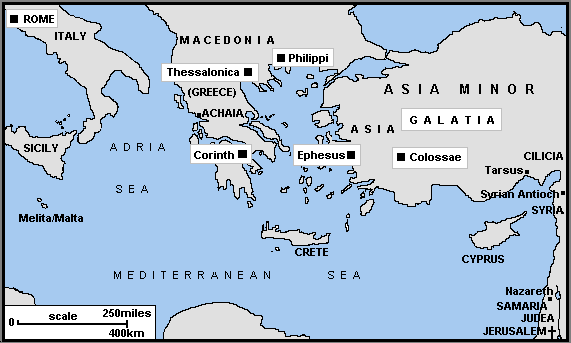
It is believed that Paul wrote this letter during his stay in Corinth (see map (if you want to)).  Though Paul was probably on his third missionary journey by now, we learn in Chapter 1 that his travels had not yet brought him to Rome. But he was eager to visit the church that had long been established there!
Throughout Romans, we will see Paul outline the foundations of the gospel.  The Greek word for the gospel is  εὐαγγέλιον.  (That’s not a computer error, that’s how it looks in Greek.)  The transliteration is euaggelion, which means good news or glad tidings.   In the first few chapters, Paul focuses on the basics of the gospel which are essentially, God’s holiness, man’s sin, and the saving grace offered by Jesus Christ.  In Chapter 1, Paul emphasizes that righteousness is given by God and received through faith in Jesus Christ.  Since he had not been able to communicate with the church face to face, Paul wanted to be sure that there was no room for misinterpretations or confusion caused by false teachers. 
As we head into this study, we can set Romans 1:16-17 as a summary of Paul’s message to the church. 
“For I am not ashamed of the gospel, because it is the power of God that brings salvation to everyone who believes: first to the Jew, then to the Gentile.  For in the gospel the righteousness of God is revealed—a righteousness that is by faith from first to last, just as it is written: “’The righteous will live by faith.’”

#TalkThirtyToMe

Image result for 30th birthday image

So today I sit on the cusp of turning 30!!!!!! I can’t believe I am allowed to call myself an adult.  I honestly do not feel like I’m 30! (Well, technically still 29 but you know what I mean).  I stood and looked at myself in the mirror yesterday, choosing to ignore what might be dark circles under my eyes, and said, “25, yeah, I feel more like 25, maybe early onset 26, max”.

I’ve been thinking about turning 30 on and off for the past few months.  At times, I’m tickled by it!  Truth be told, I’m just out here trying to remember how to keep putting one foot in front of the other.  I may not be that great at ‘adulting’, but I’ve sure got some people fooled!

Then other times, scarier times, I think about turning 30 and a range of emotions hits me like a ton of bricks.  I think it’s interesting that each year forward, we always find ourselves looking backward.  We tend to look back and say, what have I accomplished or learned over these [29] years?  Has my life amounted to what I hoped it would by this point?  Have I achieved any great milestones? The game of ‘Where Am I’, if you will.  Listen, I am a super competitive person so I don’t like to play games I can’t win.  This is a game I NEVER win.  Yet, this week I find myself sitting at the table telling the dealer to ‘hit me again’.

I’ve been reading a few posts and threads about turning 30 and all the things you should do before turning 30, or things that will change after you turn 30,  things you should no longer do after turning 30, or things that you should have by the time you turn 30.  I found myself looking to the internet to tell me what I should be feeling or doing, or not feeling or doing all because I’ve lived another 365 days (technically just one more day).

In the middle of writing this post and thinking about these things, God took me in a different direction.  I was just about to put on my sack cloth and ashes and go out to the county line to sing the song of the entitled called ‘Woe is Me, I Suck at Life’ when I heard God asking me, ‘Who told you that?’  Who told you your life was suppose to look like that? Who told you that you were suppose to have that, or live here, or work there, or have a certain net worth?  Basically, who is defining you?

This is similar to the question God asked Adam and Eve when they were in the Garden of Eden after they had sinned and hidden themselves from God.  See Genesis 3:8-11 below.

And they heard the sound of the Lord God walking in the garden in the cool of the day, and the man and his wife hid themselves from the presence of the Lord God among the trees of the garden. But the Lord God called to the man and said to him, “Where are you?” 10 And he said, “I heard the sound of you in the garden, and I was afraid, because I was naked, and I hid myself.” 11 He said, “Who told you that you were naked? Have you eaten of the tree of which I commanded you not to eat?”

I love Genesis and I could go on and on about this passage but the thing that stands out to me today in these verses is that God wanted to make them aware of the fact that they had allowed someone or something else to tell them what ‘truth’ was.

Here I was letting Google, well-intended people, television shows and romantic comedy movies tell me who I should be and feeling shame and guilt for being so far away from that ‘reality’, when God, in His perfect, loving-kindness came rushing in to ask me, “who are you listening to”.

For the sake of everything holy, I hope that the legacy of my life is not based on what I did or owned by the time I was thirty.  How meaningless and shallow!  I want the legacy of my life to be that I knew Christ and I proclaimed His name in a way that drew men and women closer to Him.  If that life includes a brick house, a savings account, 401k , a husband,2.5 kids and a business professional wardrobe, GREAT!  If it doesn’t, GREAT!

Since I can’t help but look back at the last 29 years, I’ll say this about them, I wasn’t faithful to give every day of every one of those years  to God.  I wasn’t faithful in keeping my eyes on Him and seeking His plans and purposes for my life, and not my own.  But if God so chooses to bless me with 29 more, I pray for grace to make them count for His kingdom.  And grace to be found in Him, defined by Him, and validated by Him alone.

What have I accomplished in 30 years? Not much.  But what has God accomplished in me in those 30 years?  More than eyes can see or simple human minds can fathom.  He redeemed me from a bottomless pit, told me that I was worth the sacrifice of His only son, Jesus, and He is teaching me to love Him more with each passing day.

God I thank You for the gift of the life that I have found in You.

So this year for my 30th birthday, I want to celebrate my family, my friends, my health and happiness.  But most importantly, I want to celebrate my God who says to me I have loved you with an everlasting love, I have called you daughter, and I have never, nor will I ever forsake you.

Happy Birthday DaVondria!! Have some cake!